Best Kayak Fishing Gear Setup: Stability Beats Speed for Almost Everyone
Why hull stability and rigging capacity matter more than glide speed for a genuinely usable fishing kayak setup.
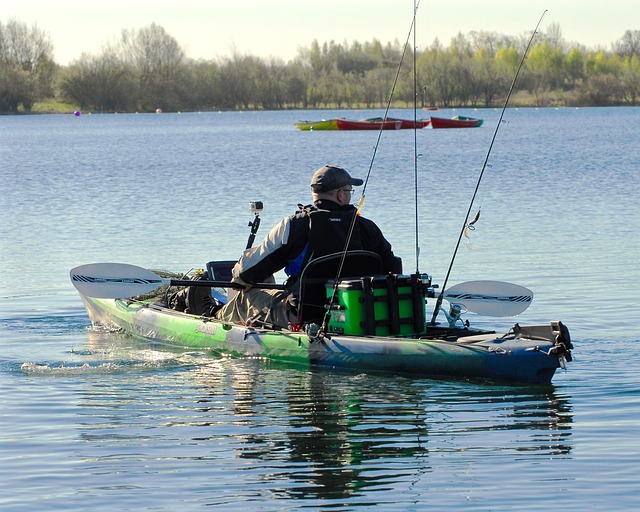
New kayak anglers consistently prioritize hull speed and glide efficiency when comparing models, then discover on their first real fishing outing that standing to cast, fighting a decent fish, or simply staying comfortable for hours matters far more than shaving a few minutes off a paddle to the fishing grounds.
Hull width and design trade speed for stability, and that trade-off matters more for fishing use than for pure paddling or touring kayaks. Wider, flatter-hulled designs give up glide efficiency but hold steadier for standing casts and fighting fish. Fishing-specific pedal kayaks commonly run 33 to 40 inches across for exactly this reason, well beyond what a touring kayak would ever need. Hobie’s Mirage Pro Angler 14 sits right at the wide end of that range: 38 inches across, 13’8” long. Hobie’s own spec sheet leans on that width explicitly, marketing the hull around six horizontal rod lockers and a stand-friendly deck rather than glide speed.
Width on a spec sheet doesn’t settle the question by itself, though. A Rokslide forum thread on choosing a pedal kayak for fishing has a poster sizing up the Hobie Mako 10 at 6’2” and 205 lbs, going in worried about stability and coming back to report handling was excellent once he was actually on the water. Elsewhere in the same thread, other posters describe specific models as tippy when reaching behind for gear despite a hull that looks plenty wide on paper. A number on a spec sheet and how a hull actually feels when you’re leaning off-center aren’t always the same thing.
Pedal-drive systems free up your hands for fishing while the kayak is moving, a real advantage for anyone working a lure or holding position while trolling. That convenience carries a weight cost few first-time buyers price in, and the real numbers run higher than most forum estimates suggest. Hobie lists the Mirage Pro Angler 14’s fitted hull weight at 120.5 lbs and its fully rigged weight (hull plus the MirageDrive 180 pedal unit, seat, and factory-installed hardware) at 144.5 lbs, before a single rod, crate, or battery goes aboard. Forum regulars swapping notes on loaded rigs often cite 90 to 120 lbs as the ballpark for a “fully rigged” pedal kayak, which undersells it: Hobie’s own number for bare rigged weight already clears the top of that range. Add a milk crate of tackle, a marine battery for a fishfinder, and an anchor system, and a loaded PA14 is realistically pushing 170 to 180 lbs on a roof rack or trailer bunk, not the 90 to 120 lbs forum shorthand implies.
That weight difference shows up in price too, not just pounds. Old Town’s Sportsman BigWater 132, sold as a straight paddle kayak, lists around $1,399.99. Add pedal drive and it becomes the Sportsman BigWater Pedal 132 Angler at roughly $3,199.99, and Old Town’s power-assisted ePDL+ version of the same hull runs about $5,499.99. Native Watercraft’s Slayer Propel 10 Max sits in similar territory, priced around $2,699 to $2,749 depending on retailer, against roughly $2,349 for the non-Max Slayer Propel 10 LTE. Hands-free pedaling is worth real money to a lot of anglers. It’s worth knowing up front that the jump from paddle to pedal on comparable hulls is routinely $1,500 to $2,000, not a minor upcharge.
Storage and rigging capacity matters more than most first-time buyers anticipate before they’ve actually loaded a kayak with real gear. Rod holders, tackle storage, and space for a small cooler or bait bucket all compete for the same limited real estate, and a hull that looked spacious empty in a showroom often doesn’t once six rod holders, a crate, and a fishfinder mount are all fighting for the same deck space.
Sit-on-top design dominates saltwater kayak fishing for good reason. Self-draining scupper holes handle water intrusion from waves or launching through surf far better than a sit-inside design, where water pooling in an enclosed cockpit becomes a genuine safety issue.
Anchor and positioning systems deserve more attention than casual buyers give them. A drift sock or small anchor system for holding position over structure matters enormously for anglers doing precision bottom fishing, and a kayak without an anchor-trolley or similar accessory makes sustained-position fishing considerably harder.
Weight capacity ratings tend to represent theoretical maximum, not comfortable practical capacity. The guidance that keeps coming up across kayak fishing forums is to look for rated capacity at least 100 lbs above your own body weight before gear ever gets added: real headroom, not a number you’re right up against, since a hull’s handling degrades noticeably as it nears its rated limit. A thread on TexasKayakFisherman.com puts a number on what “ignoring that margin” actually looks like: one member described a kayak rated for 550 lbs that got loaded down with salvaged items while paddling upstream, crept past 700 lbs total, and started taking on water before it eventually tipped. Nobody sets out to load a kayak 27 percent over its rating. It happens a crate, a cooler, and a stringer of fish at a time.
Stability at the rated limit isn’t the same as stability standing up, either. A Tidal Fish forum review of the Native Watercraft Slayer 12 has a roughly 200-lb paddler noting that switching the seat to its high position made the kayak feel tippy at first, but that the hull’s secondary stability “locked in like a champ” once he adjusted to it, letting him stand and sight-fish without issue afterward. Mechanical parts fail on their own schedule, too, independent of hull rating: a thread on Hobie’s own owner forum, bluntly titled “Keep breaking pedal cranks!”, is a reminder that a pedal drive adds a moving part a paddle kayak simply doesn’t have, and moving parts under load eventually wear out or snap regardless of how well the hull itself is designed.
A lot of beginner advice suggests starting with the cheapest available fishing kayak to “see if you like it” before spending more. Some of those cheap options are genuinely cheap: a Lifetime Tamarack Angler has shown up on clearance for around $329, and a bare-bones Lifetime sit-on-top angler kayak has been spotted at Tractor Supply for under $200. In practice, a genuinely unstable, poorly designed budget kayak at that price point can sour a new angler’s whole experience through no fault of the sport itself. A modest step up to a purpose-built, stable fishing kayak, something like an Old Town BigWater 132 at roughly $1,400 rather than a $200 big-box hull, tends to produce a better first outing than the cheapest option, even for someone unsure about long-term commitment. It also costs a fraction of what the pedal-drive versions of the same hulls run, which matters if the budget was tight enough to be eyeing a $200 kayak in the first place.
Bottom line: prioritize hull stability over speed for genuine fishing use, buy with real weight-capacity margin above your calculated loaded weight (100 lbs above body weight is the number that keeps surfacing in owner forums), and don’t underinvest in your first kayak assuming a cheap one is a safe way to “try out” the sport. Price out the pedal-drive premium honestly before committing to it. It’s closer to $2,000 than a rounding error, and that’s before tackle, a battery, and an anchor system push the loaded weight past what most buyers picture when they read “600-lb capacity” on a spec sheet.